
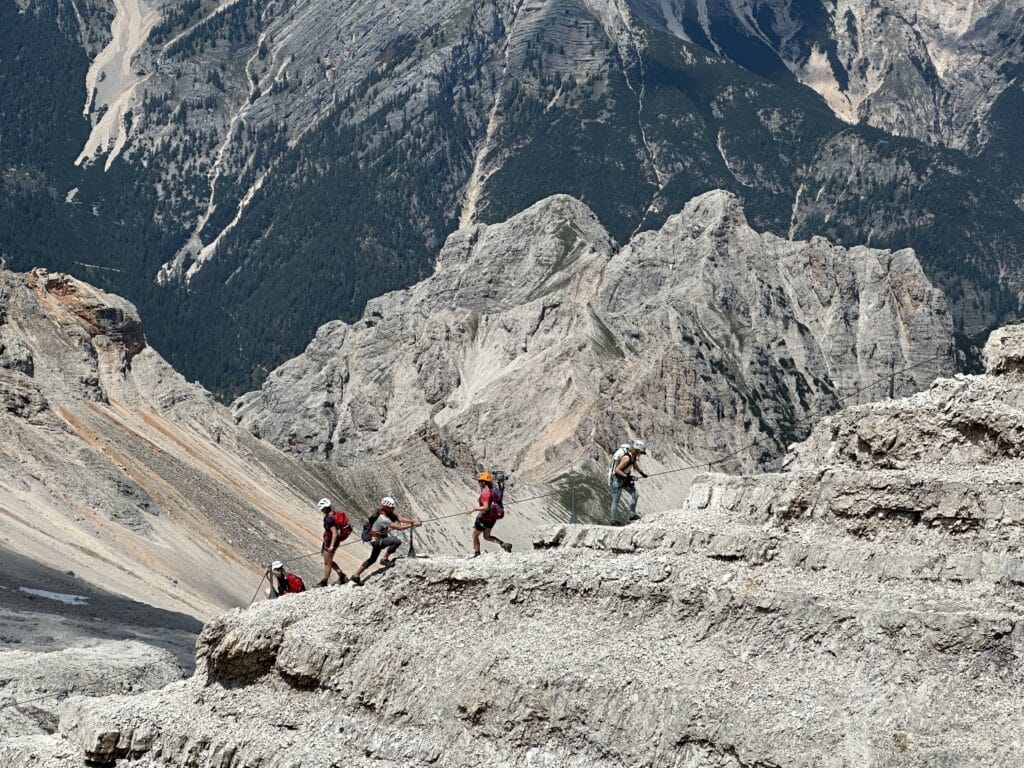

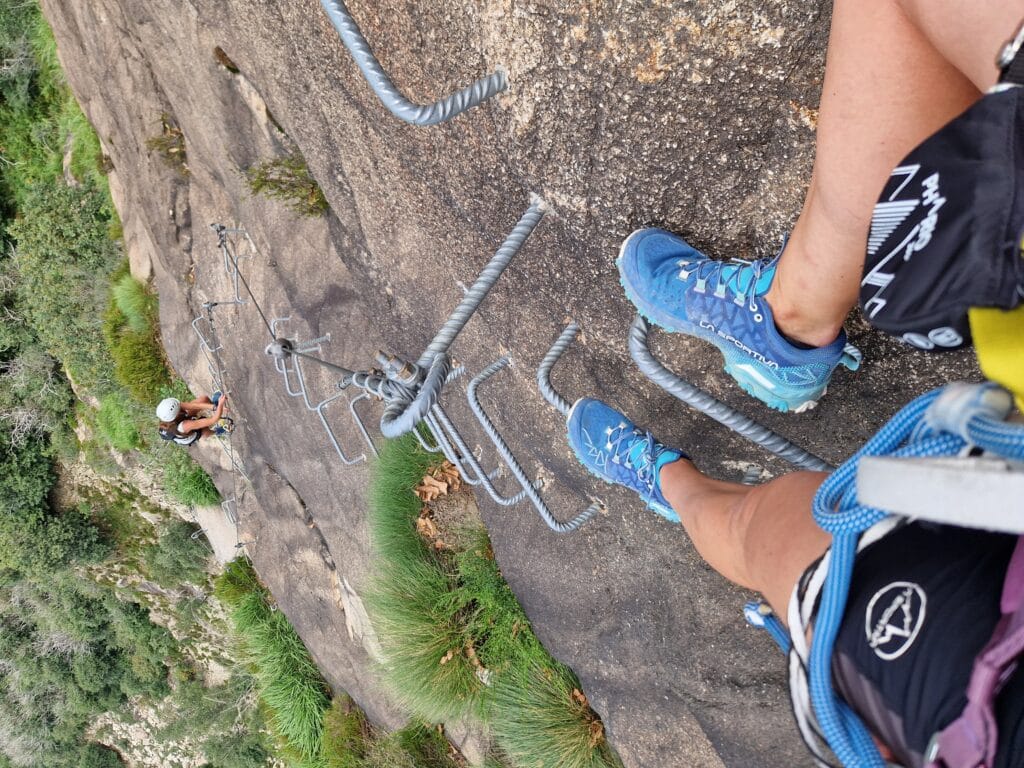
Via ferrata (translated from Italian as “iron path”) is a semi-climbing route built into the mountains, where you travel along specially prepared paths, cables, bridges and ladders. It is a pretty safe yet adrenaline filled way to reach the most impressive mountain peaks even if you don’t have professional climbing experience.
The first via ferratas appeared in Italy in the Dolomites region. They were installed during World War I to help soldiers move through difficult, mountainous terrain and provide protection from enemy attacks. After the war many via ferratas were abandoned and later renovated for tourism.
What Equipment is Needed for a Via Ferrata Route?
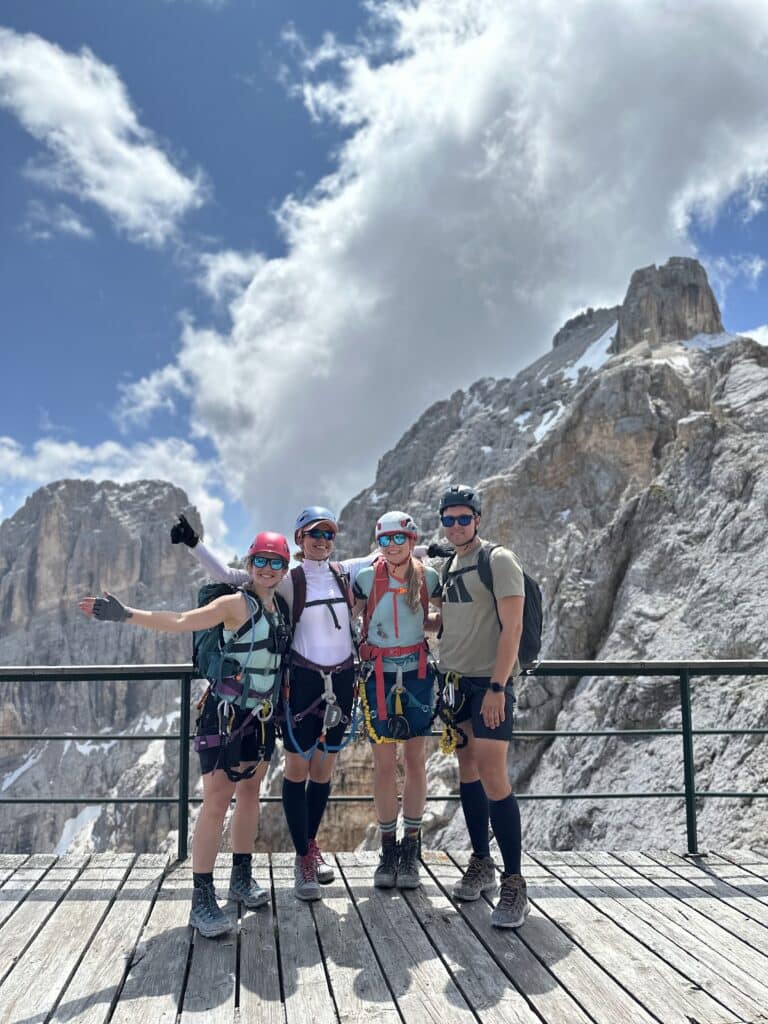
To safely complete a via ferrata route you need the right gear. Unlike a regular hike – the terrain on a via ferrata can be quite steep with many exposed areas where safety depends entirely on your preparation and the quality of your equipment.
| Via Ferrata Gear | Description | Equipment example |
|---|---|---|
| Harness | The harness is worn over your clothes and allows you to safely attach the via ferrata lanyard system. It must be comfortable and adjustable at the thighs and waist, with a central tie-in point. | Harness that I like to use: Petzl LUNA |
| Via ferrata set | This safety device attaches to a harness and connects the hiker to the iron via ferrata cable. It consists of: – Two lanyards with special carabiners that clip onto the metal cable. – An energy absorber (dynamic brake) that cushions the impact on the body in case of a fall. – A connector that attaches the set to the harness. | My favorite via ferrata set: Singing Rock PHARIO 360 |
| Helmet | Not just protection against possible falls but also against falling rocks, that are a common hazard in the mountains. Helmets designed for mountaineering or climbing are best because they are lightweight yet impact resistant. They are also well ventilated and can be worn with a headlamp on them. | My favorite helmet: Petzl METEOR |
| Via ferrata gloves | These protect your hands from friction when holding onto the metal via ferrata cables, especially on longer routes. | – |
| Headlamp | Although often forgotten, a headlamp is a must in the mountains. Some via ferratas, especially in the Dolomites, lead through tunnels or caves. Even if you aren’t planning a long route – unexpected delays or fog can make a headlamp an essential gear item. | – |
How to Use Via Ferrata Equipment?
Before starting the route it is important to check if your gear is used properly by asking yourself these questions:
- Are the harness straps buckled?
- Is the lanyard set in good condition and do the carabiners open/close properly?
- Is the helmet tightened correctly?
If you answered yes to all of that – check your climbing partners to make sure their equipment is in order too. This is a standard practice among climbers for extra safety.
If the gear looks good – you can start with the via ferrata.
Via Ferrata Climbing Rules
The via ferrata cable is divided into sections. When you start – clip in both via ferrata set carabines to the first cable section. When you need to move to the next section – unclip one carabiner and clip it onto the new section of the cable. Only then move the second carabiner. You can check the video below to see how it looks like to climb a via ferrata Ivano Dibona.
It’s a good idea to practice using the equipment in a safe environment before heading out on a route. Also for a first via ferrata you should choose one of the easiest grades – A/B. There will be more details on the via ferrata grading system below.
IMPORTANT:
- Under no circumstances should you unclip both carabiners at the same time! At least one must always be attached to the cable.
- Only one person should be on a single section of via ferrata cable at a time. In the event of a fall, this helps avoid a collision.
If you don’t want to invest in buying equipment, you can choose to rent. There are plenty rentals in the via ferrata areas.
Via Ferrata Difficulty: How to Choose the Right Route for You
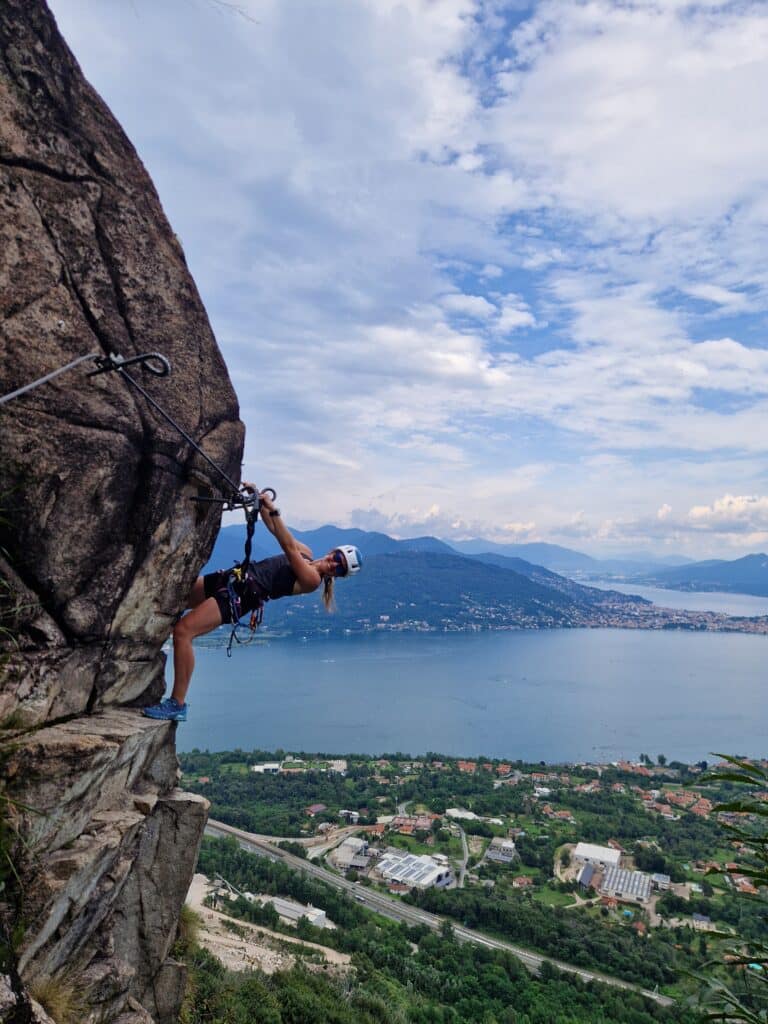
There are several different scales used to measure via ferrata difficulty: Austrian, Italian, German and French. You can read more about via ferrata markings in the document prepared by the International Climbing and Mountaineering Federation (UIAA): Via Ferrata: A short introduction.
The grading system used in the Italian Dolomites is the Austrian one. You will find this system used across the On Life and Mountains blog.
The Austrian Via Ferrata Grading Scale (Kurt Schall)
This scale describes how serious and dangerous a route is: the distance to be covered, the possibilities for escape (leave the route without finishing it), the complexity of rescue operations in case of an accident, weather influence, etc.
| Grade | Description |
| A | Short, easy route. Easily accessible, with many steps and “balconies” to comfortably place your feet. You can easily escape the route or turn back. Help could arrive quickly. |
| B | Easily accessible route. More difficult sections are immediately followed by easier ones for rest. Safety points are well-installed. Good balance may be required. 📍 For a B grade via ferrata check out the Via Ferrata Ivano Dibona in the Italian Dolomites. |
| C | Navigational skills may be required. The track is steep, with many physically demanding sections and small footholds. There are many safety points and helpful anchors, but the distances between them are large. Good physical and mental preparation is required. 📍For a B/C level via ferrata check out the Via Ferrata delle Scallette (Torre di Toblin). |
| D | Similar difficulty to C. May require short climbing elements. The route features many exposed vertical or overhanging sections. Plenty of safety points, but some difficult parts may be equipped only with steel cables. 📍For a D level via ferrata check out the Via Ferrata Aldo Roghel (Monte Popera Circuit). |
| E | Similar difficulty to D. There may be more physically demanding sections without the chance to rest. Auxiliary equipment is limited to cables only. There is no possibility to leave the route early (no escape route). |
For more via ferrata itineraries check the Via Ferratas page.
What You Need to Know Before You Go
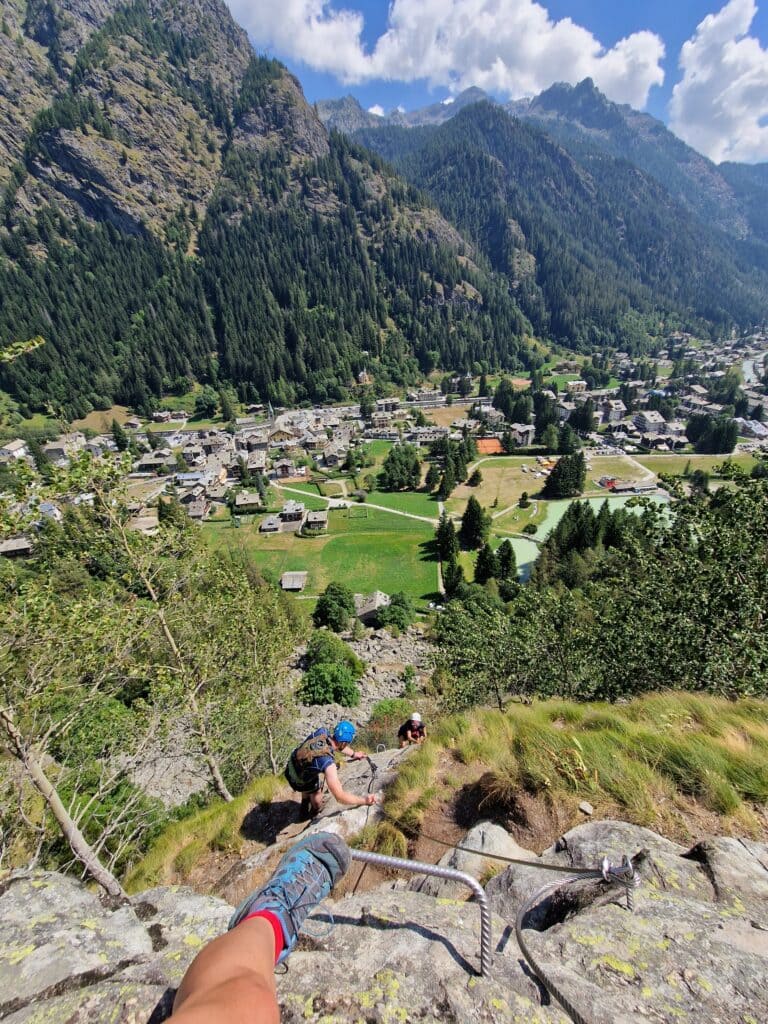
When preparing for your first via ferrata hike, it’s not just about having the right gear and knowing how to choose a route. Proper preparation and mindset are as important.
Physical Preparation is Important
Although via ferrata routes don’t require the same climbing experience needed for rock climbing, physical preparation is still important. Even easier routes can require endurance and leg and arm strength. Regular exercise such as running, stair climbing and upper body strength training will help you prepare for the physical load and delay fatigue. Being in better shape will help you feel more confident and enjoy the views.
Mental Preparation
Even though via ferratas do not involve rock climbing, however, sometimes the routes are very exposed and steep. Having tried rock climbing in a gym helps to prepare for the exposure and how to move of vertical terrain.
You Cannot Go on Via Ferrata When it Rains
Before heading out it is crucial to check the weather forecast. Rain, thunder, and strong winds can be fatal on via ferrata routes, so it’s very important to assess whether it’s safe to go. If the weather worsens while you are already on the route, it’s important to make the decision to turn back if necessary. Even if you really want to reach that summit. The summit won’t go anywhere and safety must always be the priority.
Note: for the Dolomites region the thunderstorms role in the afternoon. Therefore aim to start your day early.
- An app that I like to use for tracking weather: Windy
- For Italian Dolomites region the most accurate web app proved to be: 3Bmeteo.
Route Map
Although via ferrata routes are quite easy to follow due to the cable – navigation sometimes is needed when heading towards and from the route. Especially in remote locations. Also it’s always important to know where exactly you are when in the mountains in case something happens and you need help.
So don’t forget to plan your route at least the day before and have the map downloaded offline!
Insurance
Via ferratas are considered as high risk activities. Therefore, regular travel insurance might not cover them in case of an accident. Make sure these type of activities are included to your travel insurance plan.
If you travel to mountains multiple times per year you can consider joinings alpine clubs like Alpenveiren. Their memberships include emergencies insurance, helicopter rescue and repatriation. Also you would get discounts when staying in a lot of mountain huts.
Mountain Guides and Organized Groups
If you have doubts about choosing your first route, using equipment, or safety in the mountains, it’s worth considering going with experienced mountain guides or joining an organized group. This is a great way to gain experience and confidence, as well as to meet and chat with like minded people.
I hope this post helps you prepare for your first (or next!) via ferrata hike. Ask any questions in the comments below!
On Life and Mountains